
UDID Card: Importance, Eligibility, and Support in India
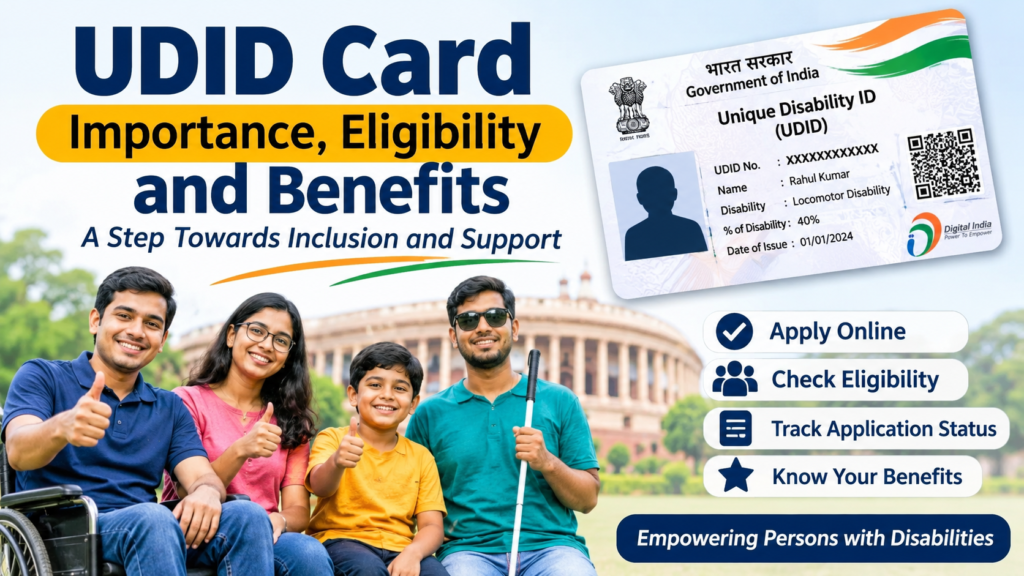
How can persons with disabilities in India access a recognized disability identity document without repeatedly dealing with different verification processes? The Unique Disability ID (UDID) system aims to make disability certification and identification more organized through a centralized online platform.
Understanding how the disability card works can help applicants and their families prepare for the application process and learn where the document may be useful.
What Is a UDID Card?
A Unique Disability ID (UDID), or UDID card, is an identification document issued to eligible persons with disabilities through the Government of India’s centralized disability certification system. It is connected with a disability certificate and helps provide a consistent way to identify and verify disability-related information across India.
The system operates under the Department of Empowerment of Persons with Disabilities (DEPwD), Ministry of Social Justice and Empowerment. Its purpose is to make disability certification and identification more accessible and organized through an online process.
The official portal is swavlambancard.gov.in.
Why Is the Unique Disability ID Important?
People with disabilities may need to provide disability-related documents when applying for government schemes, services, or other forms of assistance. Managing certificates issued through different processes can sometimes make verification difficult.
The UDID system helps address this by providing a centralized platform for disability certification and identification.
Some important aspects include:
- Common identification: It provides a recognized identification document for eligible persons with disabilities.
- Centralized records: Disability-related information is managed through an online system.
- Nationwide use: The UDID document is intended to support identification and verification across India.
- Application tracking: Applicants can check the progress of their applications through the official portal.
- Digital access: Eligible users can access available UDID services online instead of depending entirely on physical documents.
These features can make document management easier for applicants, caregivers, and relevant authorities.
Who Is Eligible for a UDID Card?
Indian citizens with disabilities covered under the Rights of Persons with Disabilities Act, 2016 can apply through the official UDID system.
Eligibility and disability certification depend on the applicable rules and assessment by the competent medical authority.
The application process may also be used by:
- People who already hold a paper disability certificate and a e-UDID card apply through the UDID portal.
- Parents or legal guardians applying on behalf of eligible children.
- Legal guardians of people who cannot complete the application themselves because of their disability.
Having a disability-related condition does not automatically mean that an applicant will receive a particular disability percentage or certificate. The competent medical authority determines the assessment and certification outcome.
For official legal information, refer to the Rights of Persons with Disabilities Act, 2016.
Which Disabilities Are Covered Under the UDID System?
The Rights of Persons with Disabilities Act, 2016, specifies 21 disabilities. The UDID system supports disability certification for eligible applicants covered by the Act.
These include:
- Blindness
- Low vision
- Leprosy-cured persons
- Hearing impairment, including deaf and hard of hearing
- Locomotor disability
- Dwarfism
- Intellectual disability
- Mental illness
- Autism spectrum disorder
- Cerebral palsy
- Muscular dystrophy
- Chronic neurological conditions
- Specific learning disabilities
- Multiple sclerosis
- Speech and language disability
- Thalassemia
- Hemophilia
- Sickle cell disease
- Multiple disabilities, including deafblindness
- Acid attack victims
- Parkinson’s disease
The applicable assessment criteria and certification requirements depend on the particular disability and relevant government rules.
Applicants should check the official portal or contact the designated medical authority if they are unsure whether their condition falls within the recognized categories.
How Does the UDID System Work?
The UDID system brings the application, medical assessment, and certification process onto a centralized online platform. However, completing an online application does not mean that a card is issued automatically.
The general process involves the following stages:
1. Submit an Online Application
Applicants can visit the official UDID portal and complete the registration and application process. They need to provide the requested personal details and upload the required documents.
2. Select or Contact the Medical Authority
The application is processed through the relevant designated medical authority. Applicants may need to contact the selected hospital or authority regarding their assessment appointment.
3. Attend the Medical Assessment
The competent medical authority reviews the submitted information and conducts the required disability assessment. The assessment helps determine the applicable disability category and percentage.
4. Verification and Certification
After the assessment, the authorized medical authority processes the certification through the online system. The application outcome depends on the assessment and verification.
5. Access the e-UDID Card
Once the application is approved and the card is generated, applicants can use the official portal and e-UDID card download to access the available card services.
Applicants who want to understand what happens after submitting an application can read this guide to check UDID card application status.
What Benefits Can a UDID Card Help You Access?
A UDID card can support identification and verification when a person with a disability applies for relevant government schemes or services.
Depending on the scheme and its eligibility requirements, disability-related documentation may be relevant to:
- Government assistance and welfare schemes.
- Disability-related pensions and financial support.
- Educational assistance and scholarships.
- Employment-related opportunities or reservations where applicable.
- Assistive devices and rehabilitation support.
- Travel concessions offered under applicable rules.
However, it is important to understand that a unique disability ID does not automatically guarantee every disability-related benefit.
Each government department, institution, or service provider may have separate eligibility conditions. These can include disability percentage, income limits, age requirements, residence criteria, and other scheme-specific rules.
Applicants should always check the current guidelines of the department responsible for the particular benefit before applying.
UDID Card and Disability Certificate: Are They the Same?
The UDID card and disability certificate are closely connected under India’s centralized disability certification system, but they are not simply two unrelated documents.
The disability certificate records the assessment and certification of a person’s disability by the competent medical authority. The unique disability ID provides a standardized identification document linked to the disability certification information.
Both are handled through the UDID system, and the competent medical authorities notified by the relevant state or union territory are responsible for issuing the certification.
People who already have an older paper disability certificate can also apply through the portal. The medical authority may decide whether a fresh assessment is required.
This distinction is useful because applicants should not assume that an old paper certificate automatically means a new unique disability ID has already been generated.
Common Things Applicants Should Check
A little preparation can help applicants avoid delays or confusion during the UDID process.
Consider these points before and after submitting an application:
- Use accurate details: Make sure your name, date of birth, and other personal information match the supporting documents.
- Upload readable documents: Blurred or incomplete documents may create verification problems.
- Keep application details safe: Save your application or enrollment reference for future use.
- Attend the assessment: Follow the instructions provided by the designated medical authority.
- Check application progress: Use the official portal to review available UDID card status updates.
- Verify scheme requirements: Check the rules of the particular benefit instead of assuming that the card provides automatic eligibility.
If an application remains pending, applicants should follow the instructions shown on the official portal or contact the relevant medical authority. Assessment timelines can vary, so applicants should avoid relying on unofficial promises of guaranteed approval within a fixed number of days.
Conclusion:
The UDID card provides a centralized way for eligible persons with disabilities in India to manage disability identification and certification. It can also make verification easier when applying for relevant government schemes and services.
Before applying, make sure your personal details and supporting documents are accurate. Follow the medical assessment instructions and check the official portal for application updates.
Most importantly, always review the eligibility rules of a particular scheme before assuming that a disability card qualifies you for its benefits.
Frequently Asked Questions About the UDID Card
1. What is the full form of UDID?
UDID stands for Unique Disability ID. It is part of the Government of India’s centralized system for disability certification and identification.
2. Who issues the UDID card?
The UDID card and associated disability certificate are issued through the online system by competent medical authorities notified by the respective state or union territory.
3. Is the UDID card valid across India?
The UDID system is designed to provide a standardized disability identification document for use across India. However, eligibility for individual schemes and services remains subject to their respective rules.
4. Can someone with an old disability certificate apply for a UDID card?
Yes. A person holding an older paper disability certificate can apply through the official UDID portal. The competent medical authority may decide whether another assessment is necessary.
5. Does having a UDID card guarantee government benefits?
No. The card supports disability identification and verification, but each scheme has its own eligibility requirements. Applicants must meet those conditions to receive a particular benefit.
6. Can parents apply for a UDID card for their child?
Parents or legal guardians can apply on behalf of an eligible child. The application and certification process must follow the official requirements.
7. Where can applicants check their UDID application status?
Applicants can use the official UDID portal to access the available application tracking services. They may need their enrollment number, UDID number, Aadhaar details, or registered mobile number, depending on the available tracking option.